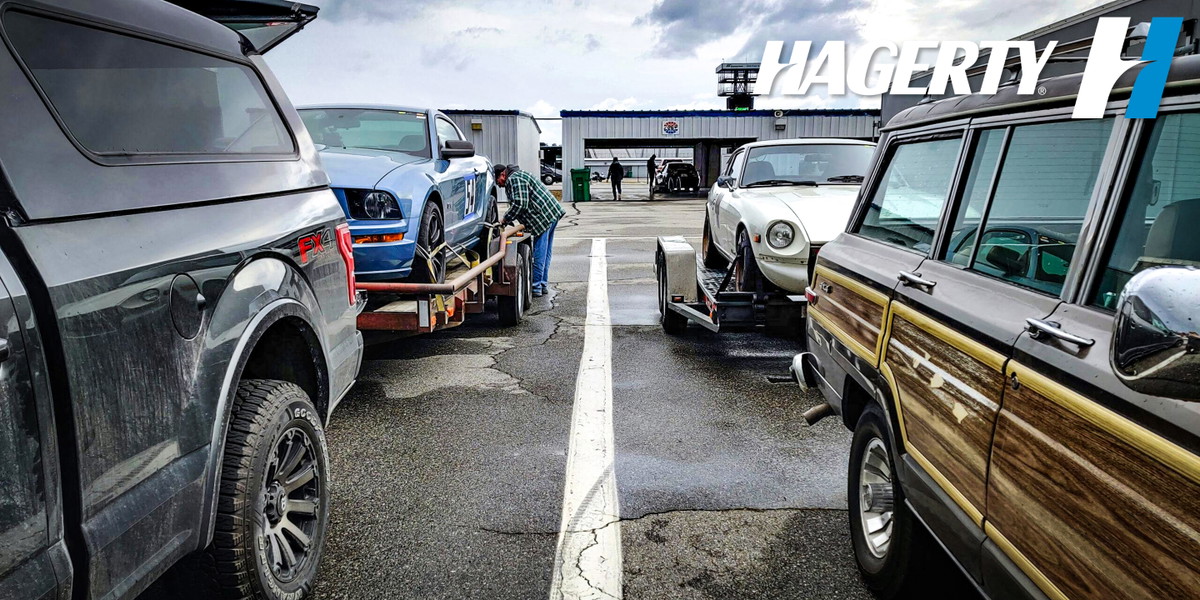
Once you’ve decided to own a competition vehicle that will need towing to the track, you’ve got a long road in front of you – not because towing is particularly difficult, but because there are a few major decisions to be made before you hit the road. For one – and this will at least partially dictate which tow vehicle you get – you need to decide what your trailer needs are. This is exactly the topic the editors at Hagerty recently tackled.
Hagerty, SCCA’s Official Insurance Partner, has a media arm that generates tons of written and video content at hagerty.com/media. Not long ago, one of Hagerty’s editors, Benjamin Hunting, stepped into the ins and outs of picking the automotive trailer that’s right for you.
“Whether it’s a fender position failure, too much tongue weight, an incompatible brake-and-hitch system, or a trailer that’s simply too bulky for the job (or too lightweight for the load), there are numerous considerations to make when trying to choose the best towing platform for your specific needs,” Hunting begins.
Before diving into the details, the article first covers safety: “No matter the trailer, improper loading and securing is typically the number one failure we see,” Chad Anderson, Material Damage Specialist at Hagerty, says in the article. “Too much weight in front of the axle or too much behind will cause a towing nightmare. A good rule to remember is the 60/40 method, with more weight in front of the axle. Also consider that too short of trailer, with a loaded vehicle hanging over anywhere, is also a recipe for disaster.”
The categories he covers are open trailers, tow dollies, and enclosed. Hunting points out that while enclosed trailers seem to have many upsides, there are also negatives to consider, like aerodynamics, ease of loading, and more.
“It can be more difficult to load a vehicle into an enclosed trailer (especially if the angle of the ramp door at the rear is too abrupt), not to mention finding one that offers you an escape door that’s properly positioned so you can exit the car after you’ve driven it inside the carrier,” Hunting points out.
“Finally, theft remains an issue, even for enclosed trailers. Thieves are often opportunists, but some bad actors might assume that since you’ve taken extra steps to protect your vehicle, it’s potentially valuable enough for them to take a risk with a break-in.”
Next, the article moves on to accessories, like tire racks, winches, lockable storage bins, ramp extenders, trailer brakes, and more.
Hunting’s conclusion? “The single best piece of advice when it comes to choosing a trailer is to have a good understanding of the type of towing you’ll be doing the most often,” he writes. “Avoiding the temptation to buy more trailer than you need – whether it’s length or weight capacity – will save you serious cash. If your tow vehicle has enough muscle, you can also probably skip springing for a lightweight aluminum chassis.”
There’s more to this story – a lot more. For that, read the entire article by clicking here.
Photo courtesy Hagerty / Benjamin Hunting